


Have you ever typed a sentence, paused, and wondered whether to write losing or loosing You’re not alone. Many people search for the loosing or losing meaning because these two words look almost identical but have very different meanings. A small spelling mistake can change the entire message, leading to confusion in emails, school assignments, social media posts, and everyday conversations.
This guide will clear up the confusion once and for all. You’ll learn the exact loosing or losing meaning discover when each word is correct, explore real-life examples, avoid common grammar mistakes, and understand related terms like loss, loose, and looser. By the end, you’ll know how to use these words with confidence and improve your writing skills in both personal and professional communication.
Quick Answer: Is It Loosing or Losing
Many english learners and native speakers alike pause when writing words that sound similar but have different meanings. One of the most common spelling questions is whether the correct word is loosing or losing. Because both words look nearly identical, it’s easy to see why so many people get confused and search for a quick, reliable answer.
Understanding the difference between these words can instantly improve your writing and help you avoid embarrassing mistakes. In this section, you’ll discover the correct spelling, learn when each word should be used, and understand the simple rule that makes choosing between loosing or losing much easier in everyday communication.
The Correct Word Most People Need
If you’re asking is it loosing or losing the correct word is usually losing. People use losing when talking about misplacing something, being defeated, dropping weight, losing interest, or no longer having something. The word loosing is much less common and only applies when something is being released, untied, or set free.
One Simple Rule to Remember
When comparing losing vs loosing, remember this simple rule: if the meaning relates to loss, defeat, or no longer having something, use losing. If the meaning involves releasing, loosening, or letting something go physically, use loosing. In everyday writing, losing is the word most people need.
Losing vs Loosing at a Glance
Understanding the losing vs loosing meaning becomes easy when you focus on context. losing means failing to keep win or maintain something, while loosing means releasing or setting something free. Because losing appears far more often in modern english, many writers mistakenly use loosing when they actually mean losing.
Also Read: 420+ Heartfelt Parents Day Quotes, Wishes & Prayers for 2026
What Does Loosing or Losing Mean
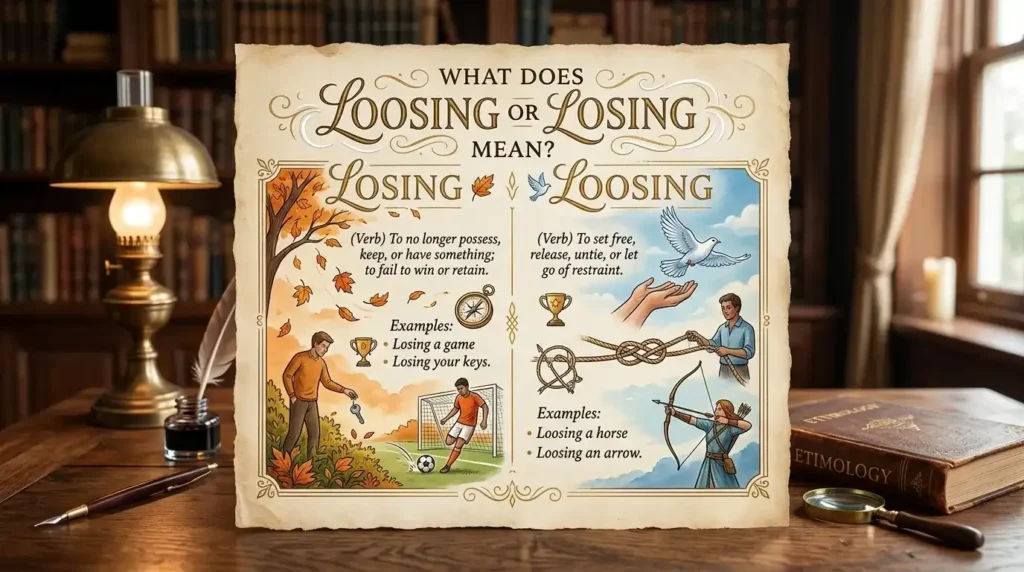
At first glance, loosing and losing may seem interchangeable, loosing or losing but they carry very different meanings in english. Understanding the distinction is essential for clear communication, whether you’re writing an email, completing an assignment, or posting online.
Many spelling mistakes happen because these words look and sound similar. This section breaks down the loosing or losing meaning in simple terms, helping you use each word correctly and confidently in everyday situations.
Losing Meaning
The losing meaning relates to no longer having, keeping, winning, or maintaining something. It can describe losing a game, losing weight, losing interest, or losing an important opportunity. Because it appears frequently in daily conversations and writing, understanding the true meaning of losing is essential for accurate communication.
Loosing Meaning
The loosing meaning is much less common in modern english. It refers to releasing, setting free, untying, or letting something go. While the word still appears in certain literary, historical, and specialized contexts loosing meaning it is rarely used in everyday writing.
Loosing or Losing Meaning in English
The loosing or losing meaning in english depends entirely on context. losing relates to loss, defeat, or absence, while loosing refers to releasing or freeing something. Knowing this difference helps prevent one of the most common spelling mistakes in the english language.
Losing vs Loosing Meaning
Understanding the losing vs loosing meaning is easier when you focus on the action involved. If something is being lost misplaced or no longer possessed use losing. If something is being released, untied or set free use loosing. This simple distinction can improve both your writing accuracy and confidence.
Losing vs Loosing: Definition, Grammar, and Usage
Have you ever reread a sentence and wondered if you spelled a word correctly, even though it looked right That happens to many writers when they encounter losing and loosing. Because the words share similar spelling and pronunciation, they often create confusion in everyday writing, emails, schoolwork, and online conversations.
Understanding losing vs loosing is more than a spelling lesson it’s about using the right word to express the right meaning. This section explains the definitions, grammar rules, vocabulary differences, pronunciation, and real-world usage so you can write with greater accuracy and confidence.
Common Expressions Using Losing
The word losing appears in many common expressions that go beyond simply misplacing something or being defeated. These phrases often describe emotions, relationships, personal growth, and everyday experiences that people encounter throughout life.
Learning these expressions helps you understand the deeper losing meaning used in conversations, books, media, and professional communication. Each phrase below carries a unique message that can help you better understand how native English speakers use the word naturally.
Losing Ground Meaning
Losing ground means gradually falling behind, weakening your position, or making less progress than before. You might hear this phrase in business, sports, education, or personal development. The losing meaning here is not about physically losing something; instead, it describes a decline in advantage, influence, or success compared to others or to your previous position.
Losing Face Meaning
The phrase losing face means feeling embarrassed, humiliated, or less respected because of a mistake, failure, or public criticism. In many cultures, reputation and dignity are highly valued, so the meaning of losing face centers on a reduction in personal honor, credibility, or social standing.
Losing Touch Meaning
Losing touch refers to gradually becoming disconnected from someone, something, or a particular skill. Friends may lose touch after moving away, or a person may lose touch with a hobby they once enjoyed. The losing meaning in this expression involves weakening a connection over time rather than experiencing a sudden loss.
Losing Track of Time Meaning
When someone is losing track of time, they become so focused, busy, or engaged that they stop noticing how much time has passed. The meaning of losing here relates to awareness rather than possession. It describes a temporary inability to monitor time accurately because attention is directed elsewhere.
Losing Sight of Your Goals Meaning
Losing sight of your goals means becoming distracted from your original plans, priorities, or ambitions. This expression often appears in discussions about motivation, success, and personal growth. The losing meaning in this context refers to forgetting or neglecting an important objective rather than physically losing something.
Synonyms and Antonyms of Losing
Words rarely exist in isolation. When learning english, understanding related words can deepen your vocabulary and help you communicate more precisely. Exploring synonyms and antonyms of losing not only improves language skills but also reveals how the idea of loss can appear in different contexts and situations.
By studying these related terms, you’ll gain a clearer understanding of how writers and speakers express success, failure, gain, and loss. This knowledge makes it easier to choose the most accurate word for any situation and avoid repetitive language in your writing.
Common Synonyms for Losing
Several words share a similar meaning with losing, depending on the context. Terms such as forfeiting, surrendering, and misplacing often describe giving up, falling short, or no longer possessing something. While each synonym has its own nuance, they all connect to the broader idea of experiencing a loss, whether intentional or accidental.
Common Antonyms for Losing
The opposite of losing often involves success, achievement, or recovery. Words like winning, gaining, and recovering represent positive outcomes where something valuable is obtained, restored, or maintained. Understanding these antonyms helps highlight the contrast between loss and progress in everyday communication.
Similar Words Often Confused With Losing
Many writers confuse losing with words such as loose and looser because they look alike. The loose meaning refers to something not tight or firmly attached, while the looser meaning describes someone or something that is less tight than another. Unlike “losing,” neither word relates to defeat, absence, or giving something up.
Expert Perspective on Losing vs Loosing
Even experienced writers occasionally stop to check whether they should use losing or loosing. The confusion is understandable because the words are visually similar, yet their meanings are completely different. Looking at the issue from an expert perspective helps remove uncertainty and promotes more accurate communication.
Grammar professionals, dictionaries, and trusted language guides consistently distinguish these words based on meaning and usage. Understanding their guidance can help you avoid one of the most common spelling mistakes in English and strengthen your confidence as a writer.
What Grammar Experts Say
Grammar experts agree that losing is the correct choice when referring to loss, defeat, or no longer having something. They emphasize that context matters and that choosing the wrong spelling can change the intended meaning of a sentence.
What Dictionaries Say
Major dictionaries define losing as failing to keep, win, or maintain something, while loosing means releasing, untying, or setting free. These definitions clearly show that the words are not interchangeable, despite their similar appearance.
Why Correct Usage Matters
Using the correct word improves clarity, professionalism, and credibility. Whether you’re writing for work, school, or personal communication, understanding losing vs loosing ensures your message is accurate and easy for readers to understand.
Expert Writing Checklist for Losing vs Loosing
A quick review before publishing can prevent small mistakes from distracting your readers. Many spelling errors happen simply because writers type quickly and rely on familiarity rather than checking the actual meaning of a word.
This practical checklist focuses on losing vs loosing and can improve proofreading, editing, and overall writing accuracy. Taking a few extra seconds to review your word choice can make your writing appear more polished and professional.
Quick Editing Checklist
Before finalizing your work, ask yourself whether the sentence refers to loss or release. If it involves defeat, absence, or no longer having something, losing is usually correct. If it describes setting something free or untying it, loosing may be appropriate.
Questions to Ask Before Using Losing
Are you talking about losing weight, losing a game, losing interest, or losing an opportunity? Does the sentence involve no longer possessing, keeping, or winning something If so, losing is almost certainly the right choice.
Questions to Ask Before Using Loosing
Does the sentence describe releasing an arrow, loosening a rope, or setting something free Is the action focused on letting something go rather than experiencing a loss If the answer is yes, loosing may be the correct word.
Common Meanings of Losing You Should Know
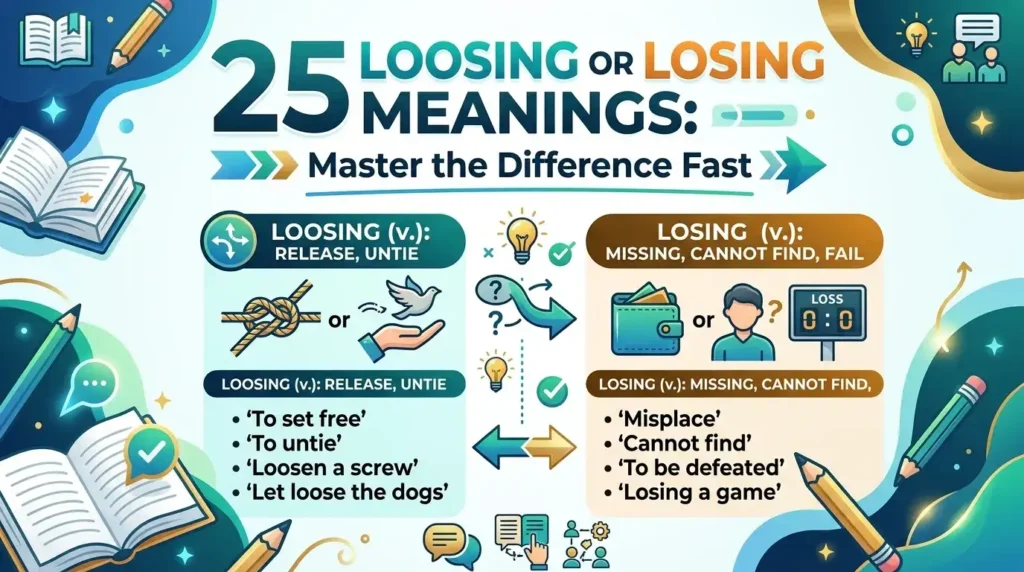
The word loosing meaning appears in countless situations, from everyday conversations to emotional life experiences. While many people think it only refers to defeat or misplacing something, the term carries a wide range of meanings that reflect personal challenges, relationships, health, goals, and growth.
Understanding these common meanings can help you interpret conversations more accurately and use the word naturally in your own writing. The table below breaks down 20 real-life meanings of losing with clear explanations and examples to make each usage easy to understand.
| Meaning | Explanation | Example |
| Losing Weight Meaning | Refers to reducing body weight through diet, exercise, or lifestyle changes. When discussing loosing or losing weight, the correct spelling is always “losing.” | She is losing weight by following a healthy routine. |
| Losing Someone Meaning | Describes being separated from someone through death, distance, or the end of a relationship. | Losing someone close can be emotionally difficult. |
| Losing a Loved One Meaning | Refers to the grief and sadness experienced after the death of a family member or friend. | Mourning the loss of a loved one takes time and healing. |
| Losing a Game Meaning | Means being defeated in a competition, sport, or challenge. | The team was disappointed after losing the final match. |
| Losing Hope Meaning | Describes feeling discouraged or believing that success is no longer possible. | He refused to lose hope despite the setbacks. |
| Losing Interest Meaning | Refers to becoming less enthusiastic or emotionally invested in something. | She started losing interest in the project over time. |
| Losing My Voice Meaning | Means temporarily being unable to speak clearly due to illness or strain. | I lost my voice after cheering at the concert. |
| Losing Myself Meaning | Describes feeling disconnected from your identity, values, or sense of purpose. | He felt like he was losing himself in the pressure of work. |
| Losing Hair Meaning | Refers to hair thinning or hair loss caused by genetics, health, or aging. | Many people worry about losing hair as they get older. |
| Losing My Mind Meaning | An informal expression meaning feeling overwhelmed, stressed, or mentally exhausted. | After a sleepless week, I felt like I was losing my mind. |
| Losing Confidence Meaning | Refers to a decrease in self-belief or trust in one’s abilities. | Repeated failures can lead to losing confidence. |
| Losing Focus Meaning | Means becoming distracted and unable to concentrate on a task or goal. | Social media often causes people to lose focus while working. |
| Losing Sleep Meaning | Describes being unable to sleep because of stress, worry, or excitement. | She was losing sleep over the upcoming exam. |
| Losing Control Meaning | Refers to no longer managing emotions, behavior, or a situation effectively. | He felt he was losing control of the conversation. |
| Losing Money Meaning | Means spending more than you earn or experiencing financial losses. | The company started losing money during the economic downturn. |
| Losing Time Meaning | Describes wasting valuable time or falling behind schedule. | We are losing time by delaying important decisions. |
| Losing Energy Meaning | Refers to becoming tired, exhausted, or less productive. | I begin losing energy in the late afternoon. |
| Losing Direction Meaning | Means lacking a clear goal, purpose, or plan for the future. | Without guidance, many people feel they are losing direction. |
| Losing Motivation Meaning | Describes a decline in enthusiasm or willingness to continue an effort. | Long-term challenges can cause people to lose motivation. |
| Losing Connection Meaning | Refers to weakening relationships, communication, or network access. | Friends may lose connection if they stop communicating regularly. |
This table highlights how the word losing extends far beyond simple defeat. Whether discussing emotions, relationships, health, finances, or personal growth, understanding these meanings helps you recognize the correct usage and avoid confusion with the much less common word loosing.
When Is Loosing Actually Correct
The word loosing meaning often creates confusion because it looks like a spelling mistake, but it is actually a real english word in specific is it losing or loosing a person. While most people searching for loosing or losing are referring to losing there are rare situations where loosing is grammatically correct and meaningful. These uses usually appear in older texts, formal writing, or descriptions of physical actions involving release or unbinding.
In modern everyday english, loosing is not commonly used, but understanding its correct usage helps you avoid mistakes and improves your vocabulary depth. Below are the situations where loosing is actually appropriate.
Loosing an Arrow Meaning
Loosing an arrow refers to the action of releasing an arrow from a bow. In this context, the word loosing meaning is connected to the idea of letting something go with force or intention. It is often found in historical writing, literature, or descriptions of archery, where precision and define loosing motion are emphasized rather than loss or defeat.
Loosing a Rope Meaning
Loosing a rope means releasing or letting go of a rope that is being held, tied, or controlled. Here loosing or losing changes meaning completely because meaning of loosing focuses on the physical act of freeing something. This usage highlights movement, action, and release rather than absence or failure.
Loosing a Knot Meaning
loosing a knot describes the process of untying or undoing a knot. It is commonly used in descriptive or instructional contexts where something is being untied step by step. The loosing meaning here is closely related to loosening tension or freeing a tied object without damaging it.
Word Origins and Etymology
Understanding the background of losing meaning and loosing meaning helps clarify why these words are often confused. Both come from different linguistic roots and evolved separately over time, even though they look similar in modern spelling.
The word losing comes from the old english losian which means to perish, be destroyed, or fail to keep something. Over time, it developed into its modern meaning related to failure, absence, or no longer having something.
On the other hand, loosing meaning comes from the old english losian and losen which relate to freeing, releasing, or unbinding. This is where modern english gets the idea of loose and loosening. The concept is connected to physical release rather than emotional or abstract loss.
From a language history and etymology perspective, these two words evolved separately but became confusing due to their similar spelling and pronunciation. Studying their word origin helps learners understand why losing vs loosing is not just a spelling issue but a meaning-based difference rooted in language evolution.
Common Mistakes People Make With Losing and Loosing
Many english learners and even native speakers often mix up losing vs loosing because the words look almost identical. This small spelling difference can completely change the meaning of a sentence. As a result, people frequently use the wrong form in daily writing, social media posts, and professional communication without realizing it.
Understanding these common mistakes helps you avoid confusion and improves your overall writing accuracy. Below are the most frequent errors people make and how to fix them correctly.
Is It Losing or Loosing a Person
When people ask is it losing or loosing a person the correct word is losing It refers to separation, emotional loss, or someone no longer being present in your life. For example, losing a loved one, losing a friend, or losing contact with someone. The word “loosing” is incorrect in this context because it does not describe emotional or personal loss.
Losing or Loosing a Game
The correct phrase is losing a game not loosing a game. When you lose a game, competition, or match, it means you were defeated or did not win. The term loosing is not used in sports or competition contexts, making this one of the most common grammar mistakes in English writing.
Is It Loosing or Losing My Mind
The correct expression is losing my mind. It is used informally to describe feeling overwhelmed, stressed, or mentally exhausted. People often search is it loosing or losing my mind but loosing is incorrect here because the phrase is about mental state, not releasing or setting something free.
Why Loosing Weight Is Incorrect
The phrase loosing or losing weight is one of the most common spelling mistakes online. The correct form is losing weight because it refers to reducing body weight over time. loosing is incorrect in this context since weight loss is not about releasing something physicallyit is about reduction, change, or decrease.
Loose, Looser, Loosening, Loss, and Losing Explained
Many people struggle with words that look and sound similar, especially when they appear in everyday writing. Terms like loose, looser, loosening, loss, and losing often create confusion because a small spelling change completely shifts the meaning. This losing vs loosing meaning section helps you slow down and clearly understand each word so you can avoid mistakes in emails, essays, social media posts, and professional communication. Once you learn the difference, your writing becomes more accurate, confident, and easy to understand for readers in any context.
Understanding these related words is not just about grammar rules it is about improving clarity in real communication. When you see these terms in real-life situations, you will no longer guess their meaning or mix them up. Instead, you will instantly recognize how each word works and why it is used in that specific sentence.
Loose Meaning
The term loose is commonly used in everyday English to describe something that is not tight, fixed, or securely attached. It can refer to clothing, objects, or even ideas that are not strictly controlled. Many learners confuse it with losing but the meanings are completely different. Understanding the loose meaning helps you avoid one of the most common spelling and usage mistakes in English writing, especially in casual communication and daily conversation.
Looser Meaning
The word looser is the comparative form of loose meaning something is less tight, less strict, or more flexible than another. It is often used when comparing two conditions, rules, or objects. The looser meaning is important because it shows degrees of looseness rather than loss or failure. Knowing this distinction helps you write more precise sentences and prevents confusion with the word losing which relates to defeat or absence.
Loosing or Loosening
The phrase loosing or loosening often confuses writers because both sound similar, but only one is commonly correct in modern english. loosening refers to making something less tight or more relaxed, while loosing is rarely used except in older or specialized contexts like releasing something. Understanding loosing or loosening helps you choose the correct form depending on context, especially in instructional or descriptive writing where clarity is important.
Loss Meaning
The word loss is a noun that describes the state of no longer having something valuable, whether emotionally, financially, or physically. It is closely related to the verb losing but represents the result rather than the action. The loss meaning is widely used in everyday language, business, and emotional conversations, making it an essential term for clear and meaningful communication.
Loses Meaning
The word loses is the third-person singular form of the verb lose used when talking about someone or something in the present tense. It describes an ongoing action where something is not kept or maintained. The loses meaning is important for correct grammar usage, especially in sentences like he loses his keys or she loses focus where subject-verb agreement plays a key role in clarity.
Meaning of Losing
The phrase meaning of losing refers to the act of not winning, not keeping, or no longer having something important. It is one of the most commonly used forms in english and can apply to games, relationships, opportunities, or personal experiences. Understanding the meaning of losing helps you interpret both literal and emotional contexts, making your communication more natural, accurate, and effective.
Related Loss Meanings You Should Understand
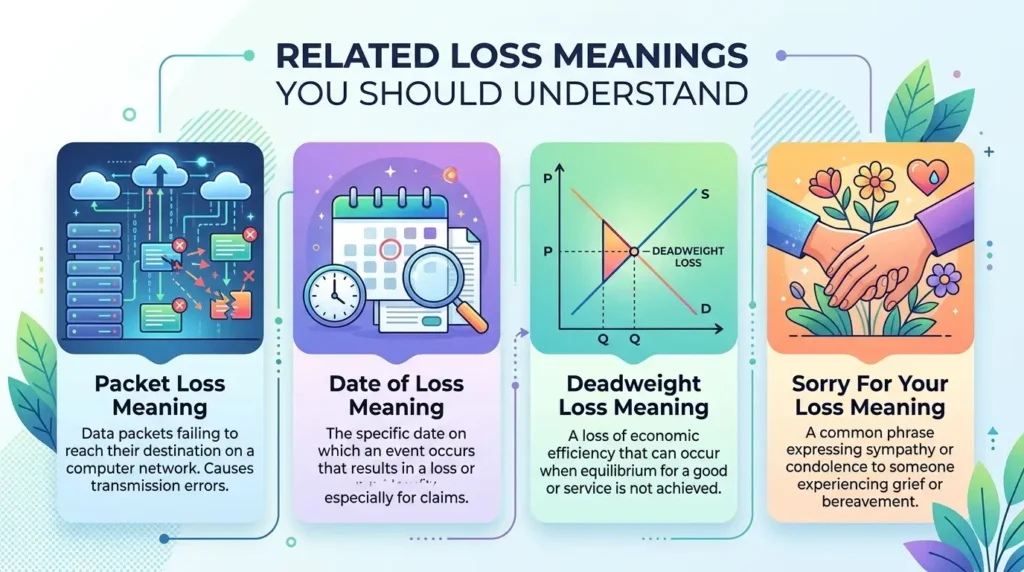
When people search for loss they are often looking for more than just a simple definition. The word appears in emotional conversations, legal terms, business language, and even technical systems, each carrying a slightly different meaning. Understanding these variations helps you interpret context correctly and use the right expression in writing and speech without confusion or misinterpretation.
This section explains the most commonly used loss expressions in real life. Each term is broken down in simple english so you can clearly understand how it is used in emotional, professional, financial, and technical situations. Once you learn these meanings, you will easily recognize them in conversations, articles, and everyday communication.
Your Loss Meaning
The your loss meaning is often used in casual conversations to suggest that someone missed an opportunity or advantage. It can sometimes sound slightly sarcastic depending on tone, but in general it means the other person has lost something beneficial by choice or mistake.
Sorry for Your Loss Meaning
The sorry for your loss meaning is a respectful expression used to show sympathy when someone has experienced the death of a loved one. It is a common phrase in emotional support situations and reflects care, compassion, and acknowledgment of grief.
Ambiguous Loss Meaning
The ambiguous loss meaning refers to a situation where loss is unclear or unresolved, such as when someone is missing or emotionally absent. It is widely used in psychology and describes emotional uncertainty that can make healing more difficult.
Date of Loss Meaning
The date of loss meaning is commonly used in insurance, legal, and financial contexts. It refers to the exact date when damage, injury, or financial loss occurred, helping determine claims, records, and official documentation.
Deadweight Loss Meaning
The deadweight loss meaning is an economic term used to describe inefficiency in a market where potential value is lost due to imbalance or poor allocation of resources. It often appears in studies of taxation, pricing, and market performance.
Packet Loss Meaning
The packet loss meaning is a technical term in networking that refers to data packets failing to reach their destination during transmission. This can result in slow internet speed, lag, or disrupted online communication.
Stop Loss Meaning
The stop loss meaning is widely used in trading and finance. It refers to a preset price level where an asset is automatically sold to prevent further financial loss, helping traders manage risk effectively.
Binding and Loosing Meaning in the Bible
The concept of binding and loosing appears in biblical teachings and is often discussed in spiritual, religious, and theological contexts. It represents authority, decision-making power, and spiritual principles related to what is permitted or restricted according to faith interpretations. Understanding this topic helps readers connect religious language with its deeper symbolic meaning in scripture and prayer practices.
This section explains how the phrase is used in the Bible and how it is understood in spiritual teachings. It also breaks down different interpretations so readers can clearly understand its meaning in both religious study and prayer life.
Binding and Loosing Meaning
The binding and loosing meaning refers to the authority to permit or prohibit actions, often in a spiritual or religious sense. It is commonly associated with decision-making power in faith-based teachings and represents control over moral or spiritual matters.
Binding and Loosing Meaning in the Bible
The binding and loosing meaning in the bible is linked to teachings of authority and spiritual judgment. It is often interpreted as the ability to declare what is allowed or forbidden according to religious principles, especially in Christian theology.
Biblical Binding and Loosing Explained
The terms biblical binding and loosing binding and loosing bible and bible binding and loosing all refer to scriptural concepts that describe spiritual authority and discipline. These phrases are used in theological discussions to explain how believers understand permission, restriction, and moral guidance in religious practice.
Daily Prayer of Binding and Loosing
The daily prayer of binding and loosing is a spiritual practice where believers pray for protection, guidance, and authority over negative influences. It is used in devotional life as a way to seek strength and spiritual clarity.
Prayers of Binding and Loosing
The prayers of binding and loosing refer to multiple prayer expressions focused on spiritual authority and release. These prayers are used in religious settings to ask for deliverance, guidance, and protection according to faith beliefs.
Real Examples From Business, Education, and Media
Understanding the difference between losing vs loosing becomes much easier when you see how these words are used in real-world communication. In professional environments, even a small spelling mistake can change clarity, tone, and credibility. That is why correct usage is important across workplace communication, academic writing, media writing, and modern AI writing tools.
This section shows how losing is used in practical contexts where accuracy matters most. From office emails to research papers and news articles, these examples help you understand how the correct word choice improves clarity, professionalism, and reader trust in different communication styles.
Business Communication Examples
In workplace communication, the word losing is commonly used to describe performance, profit, or progress. For example, a company may say it is losing revenue, losing clients, or losing market share. Using loosing in this context would be incorrect and can reduce professionalism in formal business writing.
Academic Writing Examples
In academic writing, precision is essential. Students and researchers often use losing when discussing concepts such as losing data, losing marks, or losing credibility in arguments. Academic language does not support “loosing” in these contexts, making correct usage important for grades and research quality.
Media Writing Examples
In media writing, clarity and readability are key. Journalists often report stories involving people losing jobs, losing trust, or losing opportunities. Since media content reaches a wide audience, incorrect spelling like loosing can weaken authority and reduce reader confidence.
AI Writing Examples
In AI writing and digital content creation, correct grammar helps improve search visibility and user trust. AI-generated text must correctly use losing in contexts like losing rankings, losing engagement, or losing traffic. Proper usage ensures better SEO performance and content quality.
Loosing or Losing Search Trends and Usage Data
The confusion between loosing or losing is very common in online searches because both words look similar and are often typed quickly without checking spelling. However, search behavior data shows that most users actually intend to find information about losing not loosing especially in contexts like weight loss, emotions, and life experiences.
Understanding losing vs loosing from a search perspective helps explain why this mistake appears so frequently in Google queries, social media posts, and everyday typing errors. It also highlights how small spelling differences can significantly affect search intent and content ranking.
Why People Search Loosing Instead of Losing
Many users accidentally type loosing because of pronunciation habits, autocorrect errors, or lack of grammar awareness. Since both words sound almost identical in spoken English, the mistake often goes unnoticed. This leads to a high volume of incorrect searches even when users actually mean losing.
Google Trends Comparison
Search trend behavior shows that losing is far more common than loosing across topics like health, relationships, and emotions. Queries such as losing weight, losing hope, and losing someone dominate search results, while loosing appears mainly as a misspelling of these common phrases.
Most Common Misspellings Online
The most frequent error is loosing weight instead of losing weight. Other common mistakes include loosing interest loosing hope and loosing my mind These patterns show that users often understand the meaning correctly but struggle with accurate spelling when typing quickly online.
FAQ’s
Is this loss meaning?
The term loosing meaning is often confused with loss but it is incorrect in most cases. Losing refers to the action of not keeping something, while loss is the result or state of something being gone.
Which Is More Common, Losing or Loosing?
The correct and far more common word is losing vs loosing shows that losing is widely used in everyday English for emotions, actions, and situations, while loosing is rare and context-specific.
Is Loosing Weight Correct English?
No, loosing or losing weight is a common mistake. The correct phrase is losing weight because it refers to reducing body weight, not releasing or freeing anything.
What Does Losing Someone Mean?
The losing someone meaning refers to separation due to death, distance, or relationship ending. It is an emotional expression used to describe deep personal loss.
Why Do People Confuse Losing and Loosing?
People confuse loosing or losing meaning because the words look and sound similar. Fast typing, autocorrect errors, and weak grammar knowledge also increase the mistake.
What Is the Difference Between Loose and Losing?
The loose meaning describes something not tight or fixed, while losing meaning refers to not keeping or winning something. Both words have completely different grammar roles and uses.
Conclusion: Loosing or Losing Meaning Explained Clearly
In the end, understanding loosing or losing meaning comes down to one simple rule: context decides everything. Most of the time, people actually mean losing whether they are talking about losing weight, losing hope, or losing someone important in their life.
The word loosing or losing often creates confusion because both terms look similar, but their meanings are very different. losing is used in everyday English for defeat, absence, or not keeping something, while loosing only applies in rare cases of releasing or untying. Once you understand this difference, you can confidently choose the correct word in writing and communication.

Usman Ahmad is the founder and content creator at BibleDailyPrayers, a faith-based platform dedicated to sharing daily Bible prayers, scriptures, and spiritual encouragement. He is passionate about helping believers strengthen their prayer life and grow closer to God through clear, Scripture-centered content. Usman focuses on creating original, user-friendly, and spiritually uplifting resources that inspire faith, hope, and consistent devotion.